All of us who use the trails share a love of the outdoors and appreciate the incredible access we have because of our trails. Whether biking, running, dog walking, or horseback riding, we all have a responsibility to be mindful of each other’s safety. The use of our trails is a gift, not a right! Thank you to Essex County Trail Association for developing this clear set of Trail Safety Guidelines.
Please treat others with courtesy and respect.
Who should yeild to whom?
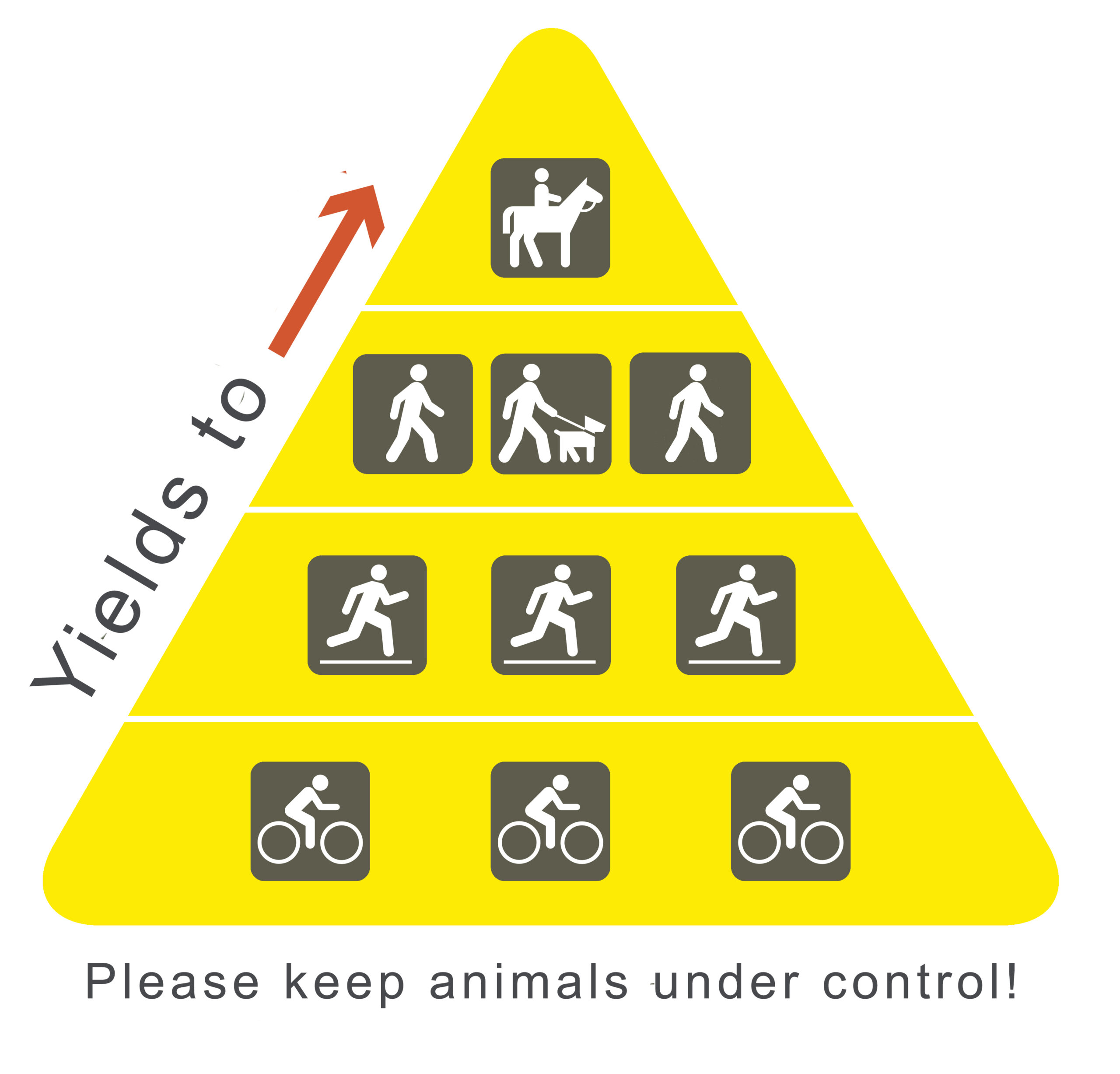
There is no hierarchy to trail use. No one type of trail user is more entitled to use the trails than any other. All trail users yield to those on horseback, next to walkers/hikers, followed by runners, then mountain bikers – who yield to everyone. There’s common sense behind this. Horses are large animals that are sometimes unpredictable, walkers are vulnerable to collisions with other trail users who are moving more quickly, and mountain bikers are the least vulnerable and travel at higher rates of speed. Please note: loose dogs without good recall ability can be a hazard to ALL trail users. Please keep your dogs under control.
There are many horseback riders who use the trails in our surrounding towns. Chances are if you’re out on our local trails you’ll encounter a horse. There are ways to approach horses safety – for your sake, and for the rider’s.
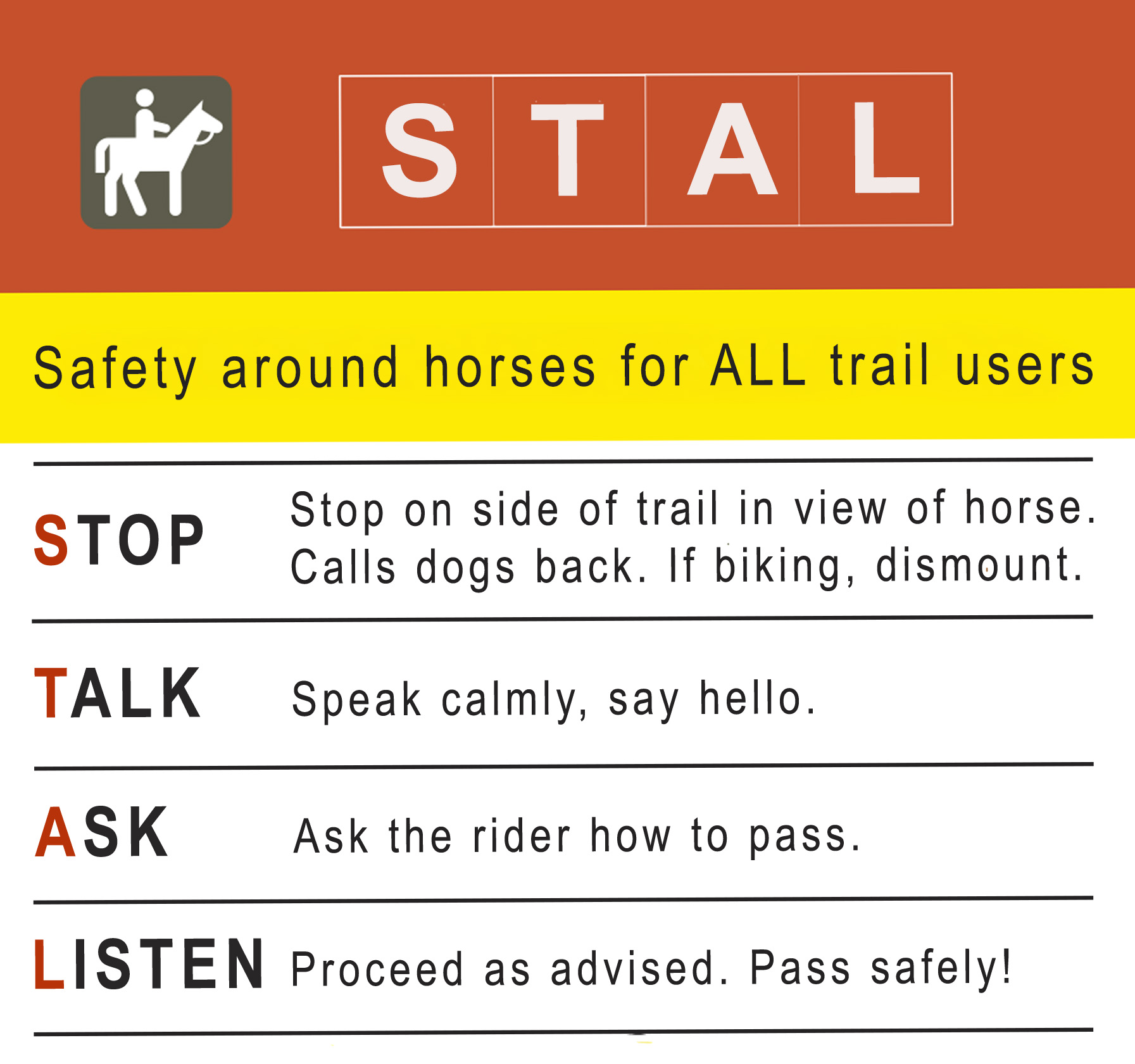
WHAT SHOULD YOU DO WHEN YOU ENCOUNTER A HORSE ON A TRAIL?
1) STOP
If you are hiking, move to the side of the trail keeping within sight of the horse. Call your dog back. If biking, slow down and then move to the side. Take EXTRA care if approaching the horse from behind. Horses cannot see directly behind themselves, so approaching from behind can be dangerous to both the equestrian and other trail users. If a horse is acting up, you may need to get off your bike. This helps the horse recognize that you are a human
2) TALK, announce yourself, say “Hello”
This is probably the most important thing you can do. If the horse sees you standing there and not saying anything, instinct tells it that you are a predator. Smile and say hello to the rider. Perhaps, try to strike up a conversation. This will calm the horse and also does wonders for relations between all trail users.
3) ASK the rider what you should do to pass safely.
Sometimes the rider will ask you to continue riding while they wait on the side of the trail. Sometimes they will pass by while you wait. Again, remember that horses have individual personalities and only the horse’s owner/rider knows that personality. Trust their judgment.
4) LISTEN to what the rider tells you to do.
Again, communication is critical: gently announce, well in advance, to let the horse and rider know that you are there and ask/wait for direction from the rider. Proceed safely!
Please Note
Equestrians
Move to the right side of the trail when approaching others and stay to the right around turns. Your horse may be another trail user’s introduction to horses. Be friendly and understanding!
Off leash Dog Walkers
It’s important that you be able to control your dogs by having the ability to call them back at will.
All Trail Users
Be respectful and courteous to all others you meet on the trails. They may be visiting the area for the first time and unsure of what to expect, or what is expected of them. Be friendly and offer guidance if needed. Help us keep trail use positive for all involved.
- Obey all posted signs and trail regulations.
- Say “Hello!”
- Leave no trace.
- Do not destroy or add additional trail markers.
- Do not disturb wildlife.
- Stay on trail, avoid trail widening.
- Absolutely no motor vehicles should be used where prohibited.
- If you are leaving deep prints (hoof, tire, or boot), it is too wet. Please do not continue.
- If you use earbuds, use in one ear only or keep the volume low enough to hear others around you.
- Share the trails. If we don’t share, we all will lose!
Did you know?
The local chapter of New England Mountain Bike Association, North Shore NEMBA, participates in “Ride with Gratitude,” a pledge made by its members to follow a code of trail use ethics: nemba.org/ride-gratitude
Remember that other trail users may not be familiar with horses and horses’ reactions to new experiences. Your horse may be another trail user’s introduction to horses. You are an ambassador for the entire equestrian community.
- Greet and thank landowners for allowing use of their property.
- Respect landowners’ privacy (talk softly when passing residences).
- Leave all gates in the position you find them.
- Mountain bikes yield to you, but since they are usually faster than horses, allow them to pass when safe to do so.
- Please stay off trails when they are wet; if you leave a deep hoof print, it is too wet.
- Ride on the edge of fields only unless otherwise indicated.
- Alert other trail users when you approach from the rear and ask permission to pass.
- Approach and pass other trail users at a walk.
- Walk by stabled or pastured animals.
- Ride single file on the road.
- Stay off cross country ski tracks.
- No dogs when riding.
- Please acknowledge motorists who slow down or stop with a wave or a thank you.
- Stay to the right, pass on the left.
- Yield to larger groups.
- Hikers coming uphill have the right of way. If you’re descending the trail, step aside and give space to the people climbing up.
- Hikers yield to horses. Slowly and calmly step off trail but stay within sight of the horse and rider. If you approach from behind, calmly announce yourself. Horses and other pack stock can frighten easily, so avoid sudden movements or loud noises.
- Mountain bikers must yield to hikers, but when possible, step aside to allow mountain bikers to pass.
- Stay on the trail. Going off trail can damage the ecosystems that surround the trail.
Be an ambassador for all mountain bikers, be respectful to both trail users and landowners.
- Mountain bikers yield to all. Ride in control and slowly around corners.
- With horses, Stop, Talk, Ask, Listen. If approaching from behind, slow down and make your presence known. You don’t realize how quiet you are and horses are easy to startle. When meeting horses face on, please stop and say “Hi.” It helps the horses to not be frightened and become more accustomed to others on the trail.
- Please help maintain trails. If your tires are making deep ruts the ground is too wet, walk or carry your bike through wet areas to help preserve the trail system.
- Stick to existing trails, do not create unauthorized trails or jumps.
For more information and tips on trail riding please visit the New England Mountain Bike Association at NEMBA.org.
- Pick up after your dog and dispose of your bags appropriately.
- Keep dogs leashed on trails that require dogs be leashed.
- Make sure your off-leash dog is under voice control at all times.
- Be respectful of leashed dogs in an off-leash area. The owners may be training the dog and/or the dogs may be fearful of other dogs. Restrain your dog until they’ve gone by.
- Call your off-leash dog back to you when a horseback rider or bike rider approaches, restrain them and step aside off the trail until the riders have passed.
- Be aware of children or older people walking in an off-leash area. Do not allow your dog to jump on others.
Always tell someone your planned route and when you plan to return
Bring a charged phone. Doesn’t have to be on.
Check weather and trail conditions beforehand
Wearing earbuds? Wear only one, with volume low enough to maintain situational awareness
Items to bring with you on the trails
● Water/Food
● Whistle
● Flashlight
● Simple first-aid kit
- tape, small trauma shears, Benadryl, roller gauze, sunscreen, safety pins, foil emergency blanket in cold weather, ice pack in warm weather.
- K9 rescue sling if hiking with your dog